

Table of Contents
- Ozonated Oil vs Regular Oil: How Ozonation Changes Everything
- How Ozonated Oil Is Made: Controlled Oxidation, Not Guesswork
- Ozonated Oil Peroxide Content: The Number Most Brands Skip
- Ozonated Oil Stability and Storage: Keeping the Peroxide Value Intact
- How Ozonated Oils Fit Into a Skin, Oral, and Pet Care Routine
- DIY Ozonated Oil vs Commercial Grade: Where the Comparison Breaks Down
- Choosing an Ozonated Oil: What to Check Before You Buy
- Frequently Asked Questions
Last Updated: October 8, 2026
Ozonated Oil vs Regular Oil: How Ozonation Changes Everything
Ozonated oil is a carrier oil that has been exposed to ozone gas under controlled conditions, changing both its chemistry and its behavior on skin. The starting oil matters, but the ozonation is what really separates the two. This guide from Ozone Apothecary breaks down what to check before you buy ozonated oils for skin care, oral care, and pet care.
Put a drop of plain olive oil on your arm and it sits there, mostly unchanged. Put a drop of ozonated olive oil and something different happens: it releases oxygen into the tissue as it absorbs. That difference is chemistry, and it starts with the oil you choose as your base.

Why the Fatty Acid Makeup of the Carrier Oil Matters
Not every oil ozonates well. Olive oil, sunflower seed oil, and a handful of others hold up because of their fatty acid composition, specifically how many unsaturated bonds their molecules carry. Those double bonds are where ozone attaches during ozonolysis, and more attachment points mean a more thoroughly transformed oil.
Oils high in saturated fat, like coconut, resist the process. They stay thin and largely unchanged, which is why you rarely see them sold as ozonated. The carrier oil is not a neutral container. It decides how much ozone the finished product can hold and how well it spreads on skin. Viscosity climbs as the oil thickens during ozonolysis.
How Ozonated Oil Is Made: Controlled Oxidation, Not Guesswork
Ozonated oil is made by bubbling ozone gas through a carrier oil at a controlled temperature and for a measured length of time. The ozone reacts with the oil's unsaturated fatty acids, forming new compounds called lipid peroxidation products. Stop the process too early and you get a weak oil. Run it too long or too hot and you degrade what you built.
This is where DIY and commercial production part ways. A home setup often means an oxygen concentrator, a jar, and a rough guess at timing plus the danger of an explosion. Commercial production tracks temperature, gas concentration, and duration so each batch lands in the same range. That consistency is the whole point of standardization, and it is the difference between a product you can rely on and one that varies jar to jar.
Ozonated Oil Peroxide Content: The Number Most Brands Skip
Peroxide content is the measurement that tells you how much reactive oxygen the oil actually carries. Many sellers publish an oxidative potential figure instead, which sounds similar but does not measure the peroxide level in the finished oil. Those are two different numbers, and only one tells you what is in the jar.
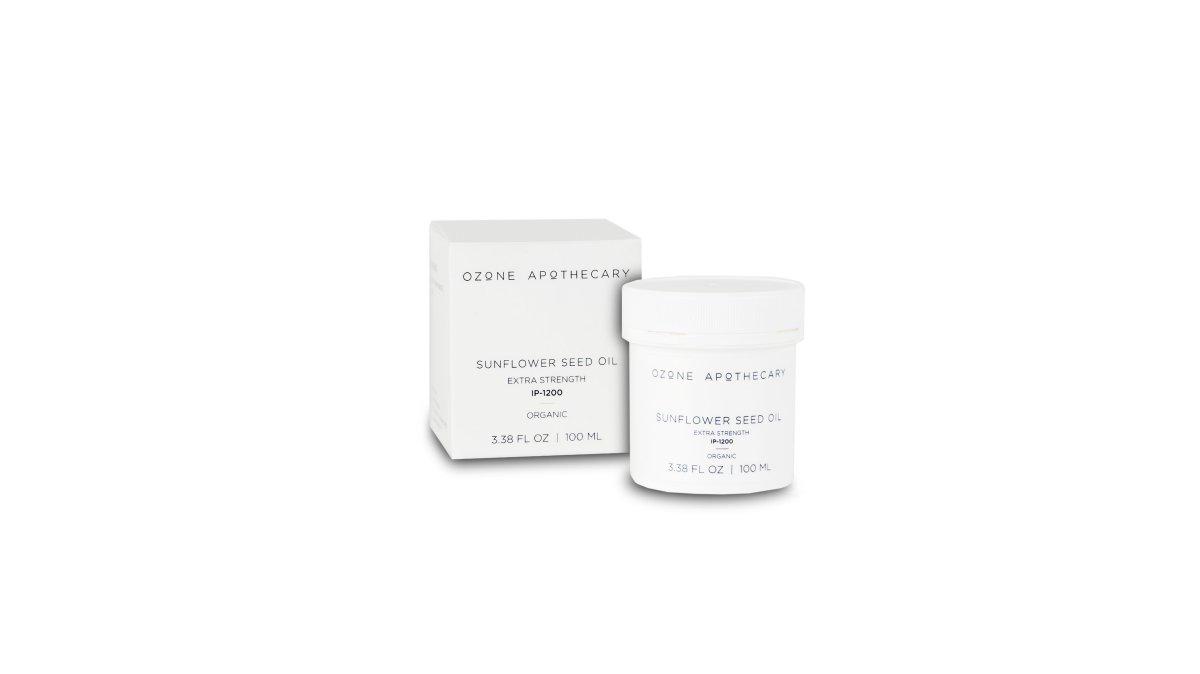
Ozone Apothecary's ozonated sunflower seed oil carries an IP-1200 rating, a measurement of the overall peroxide level in the product. We provide it because a peroxide value is the number that actually reflects what the oil delivers. When a brand skips this figure, you have no way to compare one jar against another or to know whether a batch was tested at all.

Here is what to look for on a label:
What to Check |
Why It Matters |
|---|---|
Peroxide value (PV) |
Shows how much reactive oxygen the oil carries |
Carrier oil named |
Olive and sunflower behave differently on skin |
Batch or lot number |
Lets you trace a specific production run |
Storage instructions |
Peroxide levels drop when oil is stored poorly |
Ozonated Oil Stability and Storage: Keeping the Peroxide Value Intact
Ozonated oil stability comes down to three things: light, heat, and air. Peroxide levels fall over time, and they fall faster when oil sits in sunlight or a warm bathroom cabinet. Store your jar somewhere cool and dark, keep the lid sealed.
A plastic container is fine. The idea that only glass protects ozonated oil is a myth, and a well-sealed plastic jar does the job as long as it blocks light and air. What actually damages the oil is exposure, not the material of the jar.
How Ozonated Oils Fit Into a Skin, Oral, and Pet Care Routine
Ozonated oils slot into a routine without replacing it. On skin, a small amount of ozonated olive oil works as a moisturizing step for dry or irritated areas. For oral care, ozonated products support a clean-feeling mouth as part of brushing and rinsing. For pets, ozonated sunflower seed oil is formulated to be safe for both animals and people.
Start with a patch test on your inner arm if your skin is sensitive. Apply a small amount, wait a day, and see how your skin responds before using it more broadly. The same caution applies to pets: test a small area first. Our sister sites, o3pets.com and o3vets.com, cover pet-specific guidance if you want more detail on animals.
DIY Ozonated Oil vs Commercial Grade: Where the Comparison Breaks Down
DIY ozonated oil and commercial-grade oil differ most in consistency and testing. A home batch can work, but you have no peroxide reading, no batch record, and no way to know if this week's jar matches last week's.
The gap widens when you look at safety. Without a peroxide value, you cannot tell a well-made batch from an under-ozonated one. That uncertainty is the real cost of DIY, not the equipment. If you enjoy the process and treat it as an experiment, fine.
But there is another layer to this comparison that most articles skip: the difference between oxidative potential and actual peroxide content. Many DIY guides and even some commercial sellers talk about oxidative potential, which is a measure of how much ozone the oil could theoretically absorb. That is not the same as the peroxide value, which measures how much reactive oxygen is actually present in the finished oil. A high oxidative potential means nothing if the oil was not ozonated long enough or if the ozone did not fully react. Only a peroxide value tells you what is in the jar.
This is where commercial standardization earns its keep. A producer who tracks temperature, gas concentration, and duration can hit a target peroxide range batch after batch. They can also test the finished oil to confirm it. That testing is not optional if you want a product that performs the same way every time. For anyone using ozonated oil on sensitive skin, on a child, or on a pet, that consistency is not a luxury.
If you are considering DIY, ask yourself what you are trying to achieve. If the goal is to learn about the process and you are comfortable with uncertainty, a home setup can be a worthwhile experiment. If the goal is a reliable product for daily use, the measurement step that commercial production adds is the part that matters most. You cannot replicate that at home without a lab setup and a way to test peroxide levels. That is the honest trade-off, and it is why we publish a peroxide value on our ozonated sunflower seed oil rather than an oxidative potential figure.
Choosing an Ozonated Oil: What to Check Before You Buy
Choosing an ozonated oil comes down to four checks: a stated peroxide value, a named carrier oil, clear storage guidance, and a maker willing to answer questions. A brand that publishes its peroxide measurement is telling you it tested the batch. A brand that only lists oxidative potential is telling you something else.
Our own Ozonated Olive Oil is made with extra virgin olive oil and medical-grade ozone, and it absorbs easily for everyday use on sensitive or irritated areas. Our Ozonated Sunflower Seed Oil carries the IP-1200 peroxide rating and is formulated to be safe for pets and people. Both come in jars designed to seal out air and light.
A few questions worth asking any seller:
- What is the peroxide value, not just the oxidative potential?
- Which carrier oil is used, and why?
- How should the oil be stored once opened?
- Is there a batch number on the jar?
Frequently Asked Questions
How is ozonated oil different from regular olive oil?
Regular olive oil is a carrier oil: it moisturizes and delivers fatty acids. Ozonated oil starts with that same carrier oil, but medical-grade ozone is bubbled through it so the fatty acids undergo controlled oxidation, forming lipid peroxidation products and a measurable peroxide value. That is why ozonated olive oil is thicker and has a distinct scent. A quality product states its peroxide value, which most plain oils never have.
What should I look for when choosing an ozonated oil product?
Check three things: a stated peroxide value, the carrier oil used, and packaging that protects the product from heat and light. Many brands only list oxidative potential and skip the peroxide content, which tells you little about what is actually in the jar. Ozone Apothecary's Ozonated Sunflower Seed Oil lists an IP-1200 peroxide level and adds beeswax for absorption. Also confirm the product is meant for topical use, not internal use, unless the label says otherwise.
How should ozonated oil skincare products be stored?
Keep the jar closed, cool, and out of direct sunlight. Peroxide content declines over time, and heat speeds that up. A plastic container is fine as long as it seals well and stays in a dark, cool spot; the goal is limiting air and light exposure, not the container material itself. Store it in a cabinet rather than a sunny windowsill, and check the label for any specific shelf-life guidance from the maker.
Is ozonated oil safe for pets with itchy skin?
Ozone Apothecary's Ozonated Sunflower Seed Oil is labeled safe for pets and people, and pet owners often use it on dry or irritated areas. It is a topical oil, not a treatment for any diagnosed condition, so if your dog has persistent itching, a vet visit comes first. For general skin and coat care, o3pets.com and o3vets.com cover how ozonated products fit into pet routines.
Switching from a plain carrier oil to a properly made ozonated oil is a small change with a real difference in how the product behaves. The challenge is finding a maker who measures what is actually in the jar instead of quoting a number that says little. Ozone Apothecary publishes a peroxide value, names its carrier oils, and formulates for skin, oral care, and pets from one family-run operation. Shop our ozonated olive and sunflower seed oils to see the difference a tested product makes.


